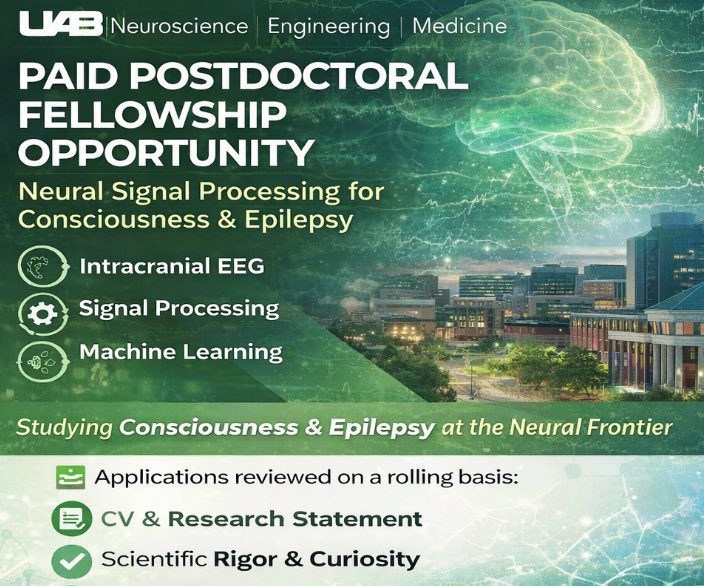
Consciousness Lab at UAB HIRING Postdoctoral researcher
Job Overview
-
Date PostedApril 3, 2026
-
Location
-
Expiration dateMay 3, 2026
-
Click to apply:
Job Description
In the Consciousness Lab, led by Jasmine Thum, M.D., MS, (jthum@uab.edu) assistant professor in the University of Alabama at Birmingham Department of Neurosurgery and Department of Biomedical Engineering, we study how the brain creates awareness—and what happens when it breaks down. By combining tools from neurosurgery, computational neuroscience and engineering, we explore how dynamic networks spanning cortex and subcortex give rise to consciousness. Our work focuses on data collected from patients undergoing invasive brain monitoring or neuromodulation for conditions like epilepsy and other movement disorders.
We also study recovery of function following peripheral nerve injury and surgical reconstruction. Our ultimate goal is to translate advanced technologies—from neuromodulation to artificial intelligence models—into personalized care that restores function and improves lives.
NOW HIRING: Postdoctoral Fellow
Institutional Overview
The University of Alabama at Birmingham is an internationally recognized research university and academic medical center within the University of Alabama System. With over $700 million in annual research funding and more than 26,000 employees, UAB is a major driver of innovation, education, and economic impact in the region. UAB is the only major academic medical center in Alabama and Mississippi and as such has a very large catchment area allowing for large patient volumes and complex cases. UAB has a Level 4 Nationally recognized epilepsy center and an Udall Parkinson’s Center of Excellence; both pair with the Center for Neuroengineering and Brain-Computer Interfaces (CNBCI) to carry out a wide range of clinical, translational, and basic science research projects and clinical trials. The institution is deeply committed to advancing interdisciplinary research, clinical care, and translational science.
Location
UAB is located in Birmingham, Alabama, a mid-sized city set against the foothills of the Appalachian Mountains. The region offers a landscape of rolling green hills, forested terrain, and highly accessible outdoor recreation with numerous national parks, lakes, rivers, climbing spots, and extensive cave systems for spelunking for the avid nature enthusiast.
Birmingham has a greater metropolitan area population of approximately 1.5 million people, with all the offerings of an urban U.S. city but also offers a relatively low cost of living and easy commutes compared to most major academic centers. Notably, the city has developed a strong reputation for its culinary scene that consistently “punches above its weight”. The city is anchored by UAB, the largest employer in the state, creating a dense academic, tech, and medical ecosystem.
The city is approximately 2.5 hours from Atlanta and is served by a well-connected regional airport with direct flights to major U.S. hubs.
Position Overview
The Consciousness Lab is seeking a postdoctoral fellow to study the neural mechanisms underlying consciousness and epileptic loss of consciousness. The lab uses human intracranial electrophysiology data from patients implanted with stereo-electroencephalography and deep brain stimulation, along with advanced computational approaches, to explore circuitry underlying levels and content of consciousness.
This is a full-time, on-site position in Birmingham, AL, designed for individuals prepared to take ownership of complex, high-value datasets and operate within a clinically integrated research environment.
Research Environment
The lab is lead by epilepsy surgeon Jasmine Thum, MD, MS, who is currently an NIH-funded Assistant Professor of Neurosurgery with joint appointments in Biomedical Engineering and Electrical & Computer Engineering. She has been at UAB for 1.5 years and completed fellowships at the University of California, San Francisco (with Edward Chang, MD, and Philip Starr, MD), and Massachusetts General Hospital. She completed Neurosurgery residency at the University of California, Los Angeles, (primary research mentor Nader Pouratian, MD), received her MD from the Health Science and Technology Program at Harvard Medical School and M.I.T. (primary research mentor Emery Brown, MD, PhD), and received her undergraduate degree in biomedical engineering and Masters degree in neuroengineering from the University of Southern California.
The lab is highly multidisciplinary, and is comprised of a research scientist, Dr. Hohyun Cho who trained with Dr. Peter Brunner at Washington University, St. Louis, graduate students, residents, medical students, and undergraduates. The lab integrates:
- Human intracranial recordings, including subcortical targets (thalamus, basal ganglia)
- Signal processing and dynamical systems approaches to brain networks
- Machine learning and AI-based modeling of seizure dynamics
- Translational neuromodulation strategies
The fellow will work with rare human intracranial datasets and collaborate across neurosurgery, neurology, and engineering.
Core Responsibilities
- Lead analysis of intracranial electrophysiology datasets
- Develop and implement computational methods for neural signal analysis
- Design and execute research studies, including data collection where applicable in the operating room and epilepsy monitoring unit
- Publish first-author manuscripts and contribute to collaborative work
- Present findings at national meetings (e.g., Society for Neuroscience, ASSC, ASSFN)
- Contribute to grant development and new research initiatives
- Mentor students and junior trainees
Qualifications
Required
- PhD in neuroscience, biomedical engineering, electrical engineering, computer science, physics, or related field
- Strong background in signal processing, data analysis, or computational methods (Matlab or Python)
- Experience working with neural or time-series data
- Demonstrated ability to complete and publish research projects in a self-motivated fashion
- Excellent written and verbal communication skills
Preferred
- Experience with intracranial EEG or human neurophysiology
- Familiarity with machine learning approaches
- Experience mentoring students or junior researchers
- Exposure to grant writing or fellowship applications
Candidate Profile
Successful candidates will demonstrate:
Scientific Rigor
- Ability to replicate and critically evaluate published methods
- Structured approaches to validation and reproducibility
- At least one high-quality, clearly owned research project
Intellectual Independence
- Strong curiosity and sustained engagement with complex datasets
- Ability to articulate both successes and meaningful failures
- Willingness to critically evaluate existing work
Execution & Work Style
- Ability to operate in flexible, minimally structured environments
- Experience managing multiple projects and maintaining follow-through
- Strong organizational skills and attention to detail
Clinical & Professional Awareness
- Understanding of patient-centered research principles
- Ability to work within clinical workflows and multidisciplinary teams
- Professional judgment in environments where research intersects with patient care
Expectations & Structure
- Initial appointment: 1-2 years, with annual renewal based on performance and funding availability (maximum ~4 years)
- Quarterly progress reviews with defined milestones
- Weekly lab meetings (alternating Wednesday or Thursday morning)
- Regular manuscript submission
- Development of potentially postdoc grant aims by end of Year 1
- Application to postdoctoral funding mechanisms
What the Lab Provides
- Access to unique intracranial human datasets
- Mentorship focused on career trajectory and independence
- Freedom to explore creative approaches to challenging problems
- Exposure to translational neuroscience and neuromodulation
- Collaborative, interdisciplinary research environment
Application Requirements
Applicants should submit the following to jthum.uab@gmail.com:
- CV
- Brief research statement and career goals
- Description of one prior project (including role, outcome, and challenges)
- One reference letter from prior PI
- Optional: code or data analysis sample
Selected candidates will undergo a multi-stage evaluation process, including technical and scientific assessment, with a visit to Birmingham if selected for final round of interviews.
Additional Notes
This position is intended for candidates prepared to take ownership of their work, function in a high-accountability environment, and develop a clear trajectory toward independent research or advanced industry roles.
Selected Relevant publications
Toker D, Zheng ZS, Thum JA, et al. Adversarial AI reveals mechanisms and treatments for disorders of consciousness. Nat Neurosci. Published online March 24, 2026. doi:10.1038/s41593-026-02220-4
Thum JA, Malekmohammadi M, Toker D, et al. Globus pallidus externus drives increase in network-wide alpha power with propofol-induced loss-of-consciousness in humans. Cereb Cortex. 2024;34(6):bhae243. doi:10.1093/cercor/bhae243
Malekmohammadi M, Price CM, Hudson AE, DiCesare JAT, Pouratian N. Propofol-induced loss of consciousness is associated with a decrease in thalamocortical connectivity in humans. Brain. 2019;142(8):2288-2302. doi:10.1093/brain/awz169