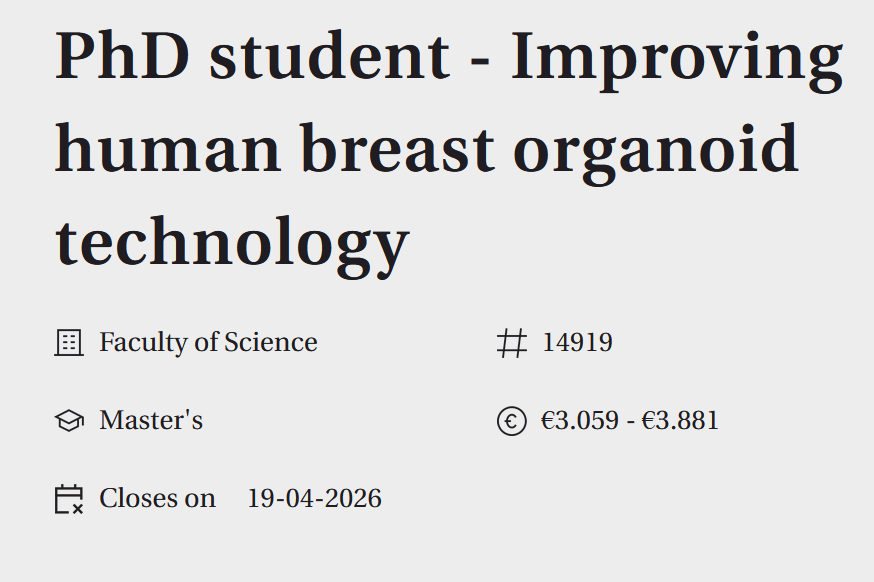
PhD student – Improving human breast organoid technology – University of Amsterdam
Job Overview
-
Date PostedMarch 30, 2026
-
Location
-
Expiration dateApril 19, 2026
-
Job Description
Want to be part of one of the most exciting edges of modern biomedical research? Buckle up and join us – on the fun journey into the miniature, yet mighty, world of advanced in vitro biology. We are looking for a driven PhD student to advance human breast organoids (3D miniaturized, simplified versions of organs grown in vitro) that offer the opportunity to observe mammary tissue dynamics under controlled conditions. Advancing human tissue-based models will help translate biomedical findings into real public health impact.
Few organs are as fundamental to mammalian identity and survival as the mammary gland. The human breast is a uniquely dynamic organ, undergoing repeated cycles of development and remodelling across a lifespan. Despite this central role, our understanding of mammary gland biology lags behind that of many other organs. Progress, in for example treating breast cancer, is constrained by the lack of experimental models that faithfully capture the complexity of the human breast.
You will establish organoids from primary human tissue obtained from volunteer donors and optimize critical culture elements (extracellular matrix, microfluidic perfusion, supplementations). Your challenge is to recapitulate key aspects of the in vivo tissue (cell type architecture, branching morphology, hormone responsiveness). In addition, you will exploit these technological refinements to obtain fundamental mechanistic insight into different aspects of the tissue (cancer, lactation).
This position is suited for someone who thrives at the interface of technology development and biological discovery.
Tasks and responsibilities:
- Complete and defend a PhD thesis within the official appointment duration of four years;
- Use multiple state-of-the-art experimental approaches to improve human breast organoid culture (including microfluidic perfusion, synthetic hydrogel engineering, confocal microscopy);
- Spearhead troubleshooting, biological interpretation, hypothesis generation and rigorous testing to obtain useful new insights for breast (cancer) biology;
- Perform your experiments in a systematic and well controlled manner and keep accurate records by thoroughly documenting and organising your work;
- Stay on top of the relevant scientific literature;
- Discuss your work in our lab meetings, incorporate feedback and give input to others;
- Assist in teaching and supervise BSc/MSc students during their research internship;
- Participate in the Faculty of Science PhD training programme.
You will get the opportunity to
- Learn a wide variety of experimental and data analysis techniques;
- Build a network as part of our (inter)national collaborations;
- Present your work at (inter)national meetings;
- Continuously hone your academic, professional and personal skills;
- Contribute to the science communication and outreach activities of the lab.